
Roof Framing
Roof structures framed straight, set with controlled pre-camber, and fixed so they stay that way under load.
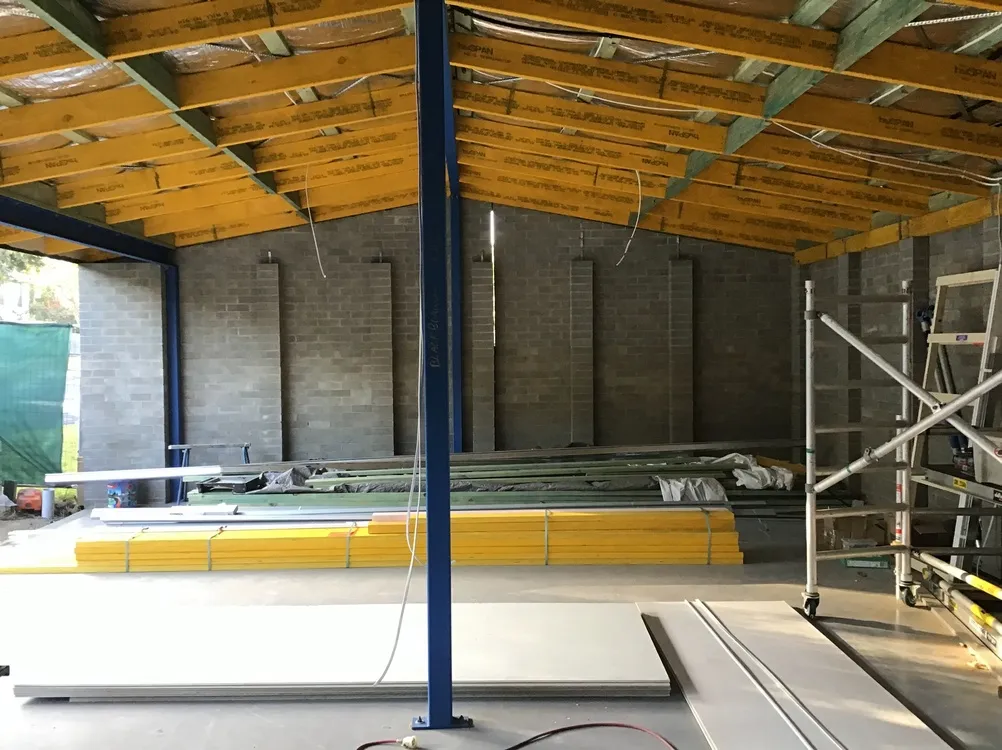
A roof doesn't decide to sag on its own. It follows whatever was wrong in the framing beneath it. A wall plate that isn't level. A set-out that drifted. A rafter cut half a centimetre too deep at the bird's mouth. Small things that add up to a roofline that looks wrong from forty metres away.
Because we correct level and straightness from slab to plate, our wall plates provide a true and consistent bearing line. Rafters seat without forcing or shimming. Roof planes close cleanly at ridges, valleys, and hips. When we install the strut system, we deliberately build in a controlled upward bow — up to 10 mm on longer spans. Timber compresses under load. A roof framed dead level will sag once the tiles or metal goes on. One framed with deliberate pre-camber settles back to level.
Bird's mouths and plumb cuts are hand-finished. Overcutting structural members at bearing points is not permitted regardless of the time it saves. All secondary members — struts, purlins, arms, blocking — are accurately cut, not overcut, and fixed with both nails and structural screws. All walls receive double top plates, including single-storey homes.
What's Included
- Double top plates on all walls — single-storey and two-storey
- Bird's mouths and plumb cuts hand-finished only — no overcutting
- Pryda rafter screws installed top plate into rafter — not nail-only
- Controlled pre-camber up to 10 mm on longer spans and heavy roofs
- String line and straightedge verification at every stage
- Collar ties included where practical to control rafter spread
- All secondary members fixed with nails and structural screws
- Hangers bolted where applicable
We provide roof framing across Sydney. Select your area for local information.
Frequently Asked Questions
What is pre-camber and why does it matter in roof framing?
Pre-camber is an intentional upward bow built into the roof frame — up to 10 mm on longer spans. Timber compresses under load, so a roof framed dead flat will sag slightly once tiles or metal roofing goes on. Framing with deliberate pre-camber means the finished roof settles back to level rather than below it.
Do you do cut roofs or truss roofs?
Both. Cut roofs where the geometry is complex or trusses won't work cleanly — intersecting roof planes, dormers, attic conversions. Prefab trusses where the geometry is straightforward and the schedule suits. The structural result is equivalent; the choice comes down to the design.
How long does roof framing take?
A standard roof takes around three days for a crew. Complex roofs with multiple intersecting planes take longer. We'll confirm the timeline with you before starting.
What are Pryda rafter screws?
Structural screws that fix the rafter to the top plate from below, preventing rafter spread and taking load off the toenailing. Standard in our work. Not standard practice on most sites — which is part of why most sites' roofs eventually move.
Do you install roof sarking?
No. Sarking is installed separately after framing by a roofing contractor. We prepare the frame correctly so whoever installs it has a true surface to work with.
Other Services
View AllWall Framing
Structural wall framing where every stud is checked, every plate is straight, and every fixing is done twice.
Subfloor Framing
Squeak-free subfloors built on a level datum — because squeaking floors are a construction failure, not a maintenance issue.
Fit Out
Internal carpentry where the quality of the frame becomes visible — in the doors that hang straight and the reveals that are consistent.