
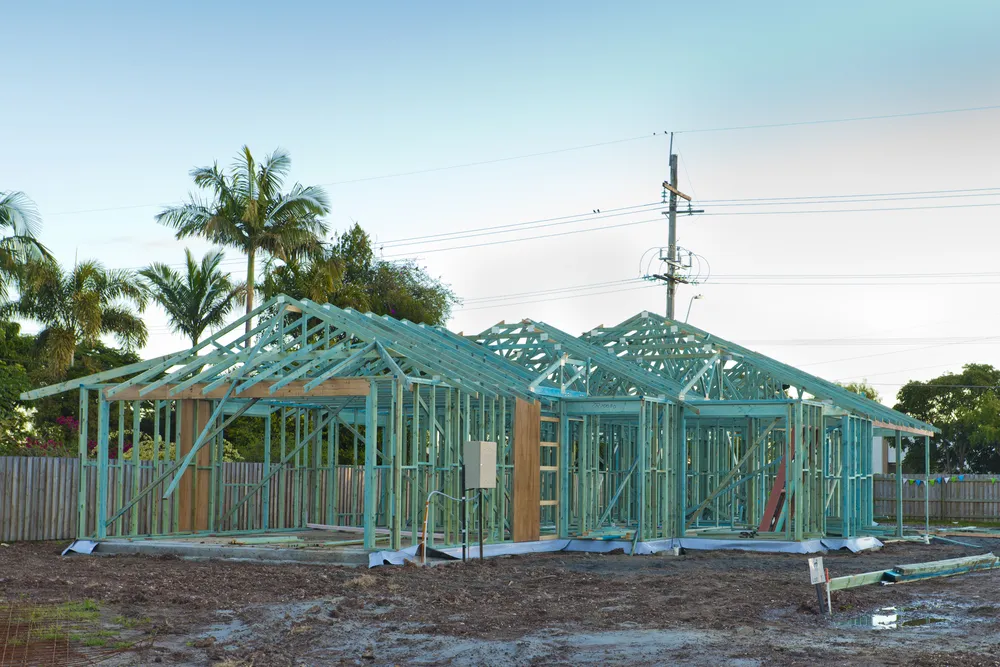
80% of carpenters in Sydney are framing with Baltic Pine. It's imported, cheaper, and moves more after installation than locally grown alternatives. Here's what that difference means in practice.
The default in Sydney residential framing
Most residential framing in Sydney uses Baltic Pine. It's available, it's cheap, it's familiar, and the framing contractors who use it have been using it long enough that they don't ask questions about it.
Baltic Pine is an imported softwood. It comes from Scandinavia and Eastern Europe — grown in one climate, kiln-dried for shipping, and arriving in Australia having already adjusted to one set of moisture conditions. When it lands in Sydney — which has different humidity, different seasonal variation — it adjusts again. That adjustment is called movement, and it shows up in the frame.
Around 80% of wall framing in Sydney uses Baltic Pine. Most of those frames hold up. The question is not whether they stand — they do — it's how straight they stay over time and what that movement costs in the trades that follow.
What Radiata Pine is and why it's different
Radiata Pine is an Australian product. Timberlink is the main supplier. It's grown in plantation conditions here, kiln-dried to local moisture targets, and by the time it arrives on a Sydney framing job, it's already acclimatised to Australian conditions.
It costs more. The timber cost difference on a full residential frame runs $2,000–$4,000 depending on frame size. Against the total cost of a residential build, that's a real but manageable number. Against the cost of correcting joinery that won't sit flush against a bowed wall, it's trivial.
The practical differences are straightness on delivery and dimensional stability over time. Radiata Pine comes off the mill straighter than Baltic Pine and holds that straightness better as the structure settles and seasonal humidity cycles through.
What the timber choice means for the frame
Before any sheeting starts, frames should be straightened — packed, shaved, adjusted where necessary — to get walls as flat as possible. This takes time and is where a lot of installation shortcuts occur. Starting with straighter timber means less time correcting.
The longer-term picture is where the real difference shows. A frame that moves significantly over the first two to three years — as timber dries, acclimatises, and settles — creates problems in the trades that followed. Plaster cracks. Joinery moves off its datum. Doors that hung perfectly at handover start to stick.
Most of those problems get attributed to the house settling. Some of it is. A meaningful portion of it is timber behaviour — specifically, imported timber that hadn't finished acclimatising when the frame went up.
We also mark all bows on individual studs before installation. Bows are oriented in the same direction within each frame run, and marked on the face so they're visible. This applies whether we're using Radiata or any other product. Predictable imperfection is manageable. Randomised imperfection is not.
Beyond the timber: LVL
For clients who want to take frame performance further, LVL — laminated veneer lumber — represents a significant step beyond Radiata Pine for dimensional stability. It's engineered from bonded timber veneers, manufactured to tighter tolerances than any solid timber, and far less susceptible to the movement that affects even well-selected Radiata Pine.
We use LVL where the brief and the budget call for it. For high-specification residential work where the joinery is expensive and the finish standard is tight, the upgrade is worth discussing.
For standard residential work where the budget is a genuine constraint, Radiata Pine in MGP10 structural grade is the correct call. Baltic Pine is not.
When the timber choice matters and when it doesn't
A non-structural partition wall in a laundry doesn't need Radiata Pine. A storage room, a simple garden shed, a garage dividing wall — the timber choice makes little practical difference in low-visibility, low-specification applications.
The choice matters when something expensive and permanent goes in front of or on top of the frame. A long kitchen run. High-end floor-to-ceiling joinery. A tiled bathroom where substrate movement cracks the grout. A staircase with tight tolerances at every rise and going.
In those applications, a frame that stays straight saves money that would otherwise be spent in workarounds. The plasterer doesn't scribe to a bowed wall. The joiner doesn't shim to a wall that's out. The tiler doesn't deal with a substrate that's moved.
The full picture of what separates above-standard from minimum-standard carpentry — beyond just timber choice — is covered in quality carpentry vs cheap carpentry: what you're actually paying for.
Frequently Asked Questions
What does MGP10 mean for timber framing?
MGP stands for Machine Graded Pine. The 10 refers to the stiffness classification — timber rated to a minimum modulus of elasticity of 10,000 MPa. It's the standard structural grade required for residential framing under the National Construction Code. Both Baltic Pine and Radiata Pine are available in MGP10.
Is Baltic Pine structurally unsafe?
No. Baltic Pine in MGP10 meets the structural requirements of the National Construction Code. The issue is not structural capacity — it's dimensional stability over time. Baltic Pine moves more as it acclimatises to Australian conditions, which affects frame straightness rather than structural performance.
Can I request Radiata Pine from my carpenter?
Yes. Ask your carpenter what timber they're planning to use and why. A carpenter who understands the difference and has a considered reason for their timber choice is in a different position from one who doesn't know what they're supplying.
What is Timberlink and are they reliable?
Timberlink is one of Australia's main plantation softwood producers, supplying structural and appearance-grade Radiata Pine to the Australian market. Their products carry the required structural grading certificates. They're not a boutique supplier — they're a mainstream Australian timber producer whose product happens to be better suited to Australian framing than imports.
How much more does Radiata Pine cost than Baltic Pine for a full house frame?
For a full residential frame, the timber cost difference is typically $2,000–$4,000 depending on frame size and complexity. Against total build cost, that's a real number — but against the cost of joinery remediation or frame straightening after the build, it's still trivial.
Sources & Further Reading