
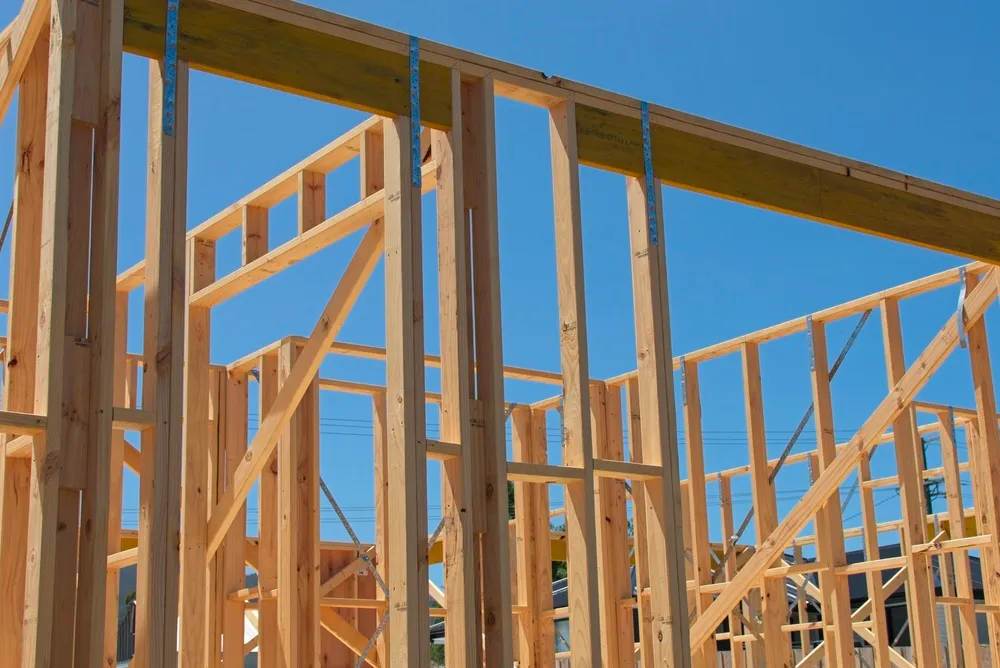
Wall framing in Sydney runs $100–150 per lineal metre for straight stud walls on a slab. A complete ground floor frame for a standard home is $10,000–20,000 depending on complexity. Here's what makes quotes vary significantly for the same job.
What wall framing costs in Sydney
The per-metre rate for wall framing on a residential job in Sydney is $100–150 per lineal metre for straight stud walls on a slab, standard ceiling height, no unusual complexity. That's a useful starting point and an almost useless number on its own.
A typical three to four bedroom single-storey home has 80–130 lineal metres of internal and external walls. At the per-metre rate, that's $3,200–7,800 for the walls alone. Add in plates, headers over openings, double top plates, bracing, junctions, temporary bracing, and the mobilisation cost of a crew, and a complete single-storey residential frame runs $10,000–20,000.
Two-storey frames — ground floor walls, floor framing between levels, upper floor walls, double top plates, temporary bracing — are $20,000–40,000 for a standard Sydney home. Complex geometry, vaulted ceilings, or unusual structural requirements push prices higher.
These are realistic estimates, not quotes. A quote requires plans, measurements, and a site visit. Be wary of any quote that arrives without plans — it's either an estimate or a price that will change once someone looks at the job properly.
What actually drives the price
Wall height. Standard residential ceiling heights in Sydney are 2.4m or 2.7m. Higher ceiling heights mean longer studs, more material, and more time to raise and brace walls that are heavier and more awkward to handle. A 3.0m ceiling height frame costs meaningfully more than a 2.4m equivalent.
Junction count and complexity. A simple rectangular floor plan with a few internal walls is straightforward to frame. A complex floor plan with multiple junctions, splayed corners, bay windows, and custom-sized openings takes more time at every step — set-out, plate work, stud layout, junction work, bracing.
Slab condition. A correctly formed slab — flat within tolerance, dimensions matching the plans, anchor bolt locations accurate — makes for a fast day one. A slab with a significant high point that becomes the datum, dimensions that don't match the plans, or bolt locations that require redrilling is an expensive day one. We walk slabs before starting and flag issues early rather than discovering them mid-frame.
Timber specification. Above-standard framing uses Radiata Pine rather than Baltic Pine — an Australian product that's more dimensionally stable under local conditions. The cost difference on a full residential frame is modest relative to the total, but it's in the materials.
Labour quality. A framing crew that checks every stud, cuts all plates on a drop saw, and orients bows consistently before erection takes more time than one that doesn't. That time is in the price. It's also in the result.
What cheap quotes are leaving out
The most common omission in a low framing quote is the assumption that the slab is perfect. It never is. A quote that doesn't include slab walking, high-point determination, and packing at slab level is assuming conditions that don't exist.
Temporary bracing. A frame that isn't correctly braced as it goes up is a frame that moves. Bracing comes out when the roof goes on — until then, the frame is held by temporary bracing. Skimping on temporary bracing isn't immediately visible. The frame passes inspection. Then the wind hits it.
Double top plates on every wall. The NCC requires double top plates on load-bearing walls. Some cheaper quotes single-plate internal non-structural walls to save time. Above-standard framing double-plates every wall — it provides a consistent fixing surface and the frame behaves consistently as a system.
Pre-locked junctions. Junctions between walls — T-junctions, corners, intersections — are either built in place or pre-locked before walls are erected. Pre-locking takes more time. It produces a junction that stays tight over time rather than one that opens as the frame settles.
Why above-standard framing costs more and what you get
The difference between minimum-standard and above-standard wall framing is not dramatic in dollar terms — typically $1,000–3,000 more on a full residential floor. It shows up in how long the frame stays straight and what the joinery looks like at handover and in year five.
Above-standard framing costs more because it takes longer. Checking every stud takes time. Cutting plates on a drop saw takes time. Pre-locking junctions takes time. Installing structural screws at end studs takes time. None of this is visible in the finished house. All of it affects the finished house.
The most expensive places to discover a frame wasn't straight are kitchens and bathrooms. A long kitchen run against a bowed wall costs money in the joinery. A tiled bathroom on a substrate that has moved costs money in cracked grout and relaid tiles. The framing cost is a small fraction of those remediation costs.
The full picture of what distinguishes quality framing from minimum standard is covered in quality carpentry vs cheap carpentry.
When not to hire us
Non-structural partitions in storage rooms, garages, or outbuildings don't need above-standard framing. A wall that will never have expensive joinery installed against it doesn't need individually checked studs.
We're structured for structural framing where the specification matters — residential floors, two-storey construction, load-bearing walls, frames that joinery and expensive finishes will follow. If the job is a single partition in a low-visibility space, there are smaller operators who will do it more economically.
Frequently Asked Questions
How much does wall framing cost per metre in Sydney?
Straight stud framing on a slab in Sydney runs $100–150 per lineal metre as a rough guide. That figure is for standard residential wall heights and doesn't account for lintels, junctions, bracing, or mobilisation costs. A complete residential floor frame is a different figure from the per-metre rate alone.
How much does it cost to frame a house in Sydney?
A complete single-storey residential frame — walls, lintels, bracing, double top plates — typically runs $10,000–20,000 in Sydney depending on floor plan complexity, ceiling height, and slab condition. Two-storey frames including the floor system between levels and upper floor walls are $20,000–40,000.
Why do framing quotes vary so much for the same job?
Specification. A quote using standard Baltic Pine, single top plates on some walls, and no pre-locked junctions will come in cheaper than one using Radiata Pine, double top plates throughout, and pre-locked junctions. The frame looks the same on day one. The difference shows up over years in how straight it stays and how the trades that follow can work.
How long does wall framing take for a single-storey house?
A two to three-person crew takes three to four days to frame a standard single-storey residential floor. Complex floor plans with many junctions and high ceilings take longer. Two-storey construction with the floor system between levels is seven to twelve days for a complete frame.
Is wall framing covered by a building warranty in NSW?
Structural framing is part of residential building work covered by the Home Building Act statutory warranty in NSW — six years for major defects, two years for other defects. The warranty runs from completion of work.
Sources & Further Reading